


Developing AI Tools to Help Canada’s Agrifood Sector Reach its Full Potential
The use of artificial intelligence (AI) across Canada’s value-added agrifood sector is growing. As the technology is proven effective at bringing benefits to the full value chain—from farmer through to retailer—companies across the supply chain are working to incorporate it into their workflow, including under Protein Industries Canada’s Artificial Intelligence program stream. By working together under this program stream, Canadian innovators are reducing inputs and costs for the agrifood system while improving its efficiency and sustainability.
Part of the Government of Canada’s Pan-Canadian Artificial Intelligence Strategy (PCAIS), the AI program helps companies across Canada’s agrifood sector adopt and implement AI technology. As of March 31, 2025, approximately $15 million of the initial $30 million investment had been committed to projects, growing to $33.1 million after leveraging industry contributions. This growing co-investment represents seven projects, three of which were launched in 2024-25.
These projects largely focused on on-farm work, focused on enabling farmers to collect farm-level data that aids in production practice decisions, protein prediction, and grain grading and quality assessment. These field-level tools, and the decisions they impact, will have ripple effects across the value chain, improving the consistency of ingredients and finished food products.
Soon, as these AI tools roll out into fields across Canada, the full agrifood sector will see the benefits of increased, improved access to in-field data, from easier agronomic decision-making to an increased ability to meet consumer expectations.
Explore all our Artificial Intelligence projects


7
Artificial Intelligence projects

36
AI-related IP assets

96%
of funds allocated to SMEs
C-Merak Innovations using AI to benefit the full agrifood value chain
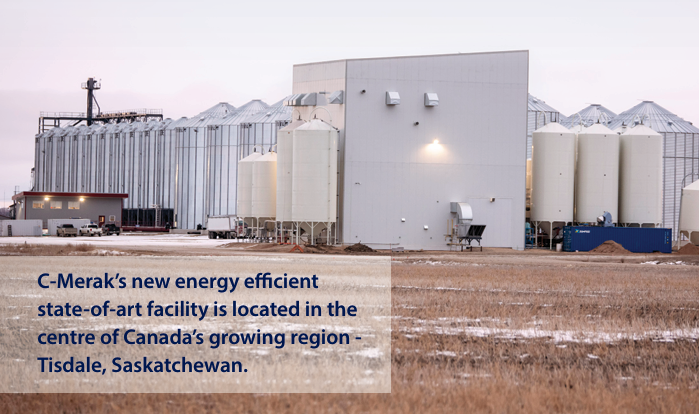
With the expected growth of the global ingredient manufacturing, food processing and bioproducts sector, seizing opportunities often means implementing new technologies that are still finding their place in the sector. For many companies, artificial intelligence is at the top of this list. Canada’s agrifood sector has been relatively slow to fully adopt the technology, but those companies who have implemented it have found it to be largely beneficial.
“AI has a role to play across the entire value chain,” C-Merak Innovations CEO Brett Casavant said. “It gives us the capability to bridge data sets from the consumer to producer to food manufacturing. Better data means better analysis and insights for decision-making. AI through machine learning can introduce efficiencies and continuous improvement across business processes. It strengthens our ability to have traceability, food safety and food security.”
With C-Merak’s focus on developing plant-based protein ingredients for Canada’s agrifood market, working with farmers and technology companies to develop AI tools that help improve crop quality and yield was a natural choice for the company. Casavant sees great potential in Canada’s growing value-added agrifood market, particularly as consumers look toward less-processed, better-tasting products. The push for these types of products, he said, is leading consumers to want to know more about their food purchases; AI can help them achieve that.
Developing that AI and the technology to implement it, however, will take a coordinated approach across the value chain.
“Fixing only one part of the value chain alone will not achieve the complete results we need,” Casavant said. “It is critical that solutions are developed cohesively through the value chain. They must be practical and have a sound business case for implementation in order to create benefits for all stakeholders. We are collaborating with our consortium partners and Protein Industries Canada to unite expertise from different sectors — from farming to processing to technology. The experience has been eye opening. We are learning to better define and appreciate the complexity of transforming what we do and how we do it from multiple perspectives.”
Not only does working across the value chain help to develop AI tools faster and more completely, it also helps ensure the end result meets the needs of the full value chain. While Casavant is partly focused on creating an AI tool that provides traceability and food safety benefits that ripple down to consumers, he explained that the technology will also help provide farmers with better data that can improve their practices and provide new market opportunities.
“AI-powered tools can provide real-time crop health monitoring essential for maximizing yields in protein-rich crops. These advancements are making Canadian plant proteins higher quality, more sustainable, and globally competitive. Higher demand for these proteins means better pricing and greater returns for farmers.”
With continued investment into AI tools across Canada’s ingredient manufacturing, food processing and bioproducts sector, companies across the value chain will continue to see new benefits and increased opportunities. Seizing them is just a matter of learning how best to implement the tool.

