
Farm Credit Canada’s strategic support helping Canadian food and agriculture sector become an economic superpower
- Posted:
For many in Canada’s capital community, investing in the country’s food production and agriculture sector is about more than seeing a direct ROI. It’s about supporting a growing leader in Canada’s economic growth.
“Ag and food is a superpower as it relates to the Canadian economy,” Farm Credit Canada (FCC) VP Strategic Finance & Business Development Graeme Millen said. “Ag and food already represents seven per cent of our GDP, that’s an amazing baseline … if we can increase productivity in agriculture by two per cent per year, that'll drive a $30 billion income opportunity for Canadian farmers over the next 10 years.”
Millen and the team at FCC recognize that Canada’s food and agriculture companies can’t reach this target alone; it requires a collaborative, coordinated effort across the value chain, including from ecosystem partners and other capital providers. For its part, FCC has focused on supporting companies in two key ways: providing capital and adding strategic value to help producers and companies as they grow and scale.
FCC supports food and agriculture companies through several capital solutions, but one of their most significant recent commitments is their May, 2025 commitment to invest $2 billion in ag and food innovation by 2030. Then, in February 2026, FCC also announced it had convened a coalition of more than 20 investment organizations collectively prepared to deploy up to $5 billion into Canadian agriculture and food innovation in the same time period. It’s a stream of investment meant to both support and align with the sector’s goal to strengthen Canada’s economy and share of the food and ingredient market to become a global food superpower.
However, Millen explained that making the investment successful also means ensuring companies across the sector have access to the expertise and support they need.
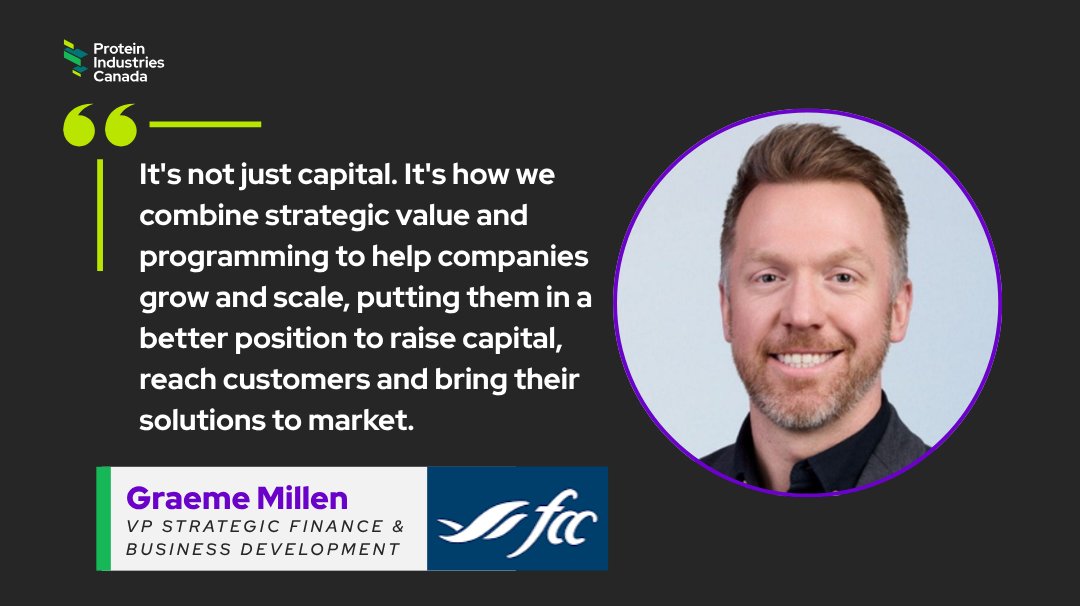
“We intentionally set up a dedicated value creation team focused on one question: how do we increase the probability of success of entrepreneurs building companies in this sector?” he said. “It's not just capital. It's how we combine strategic value and programming to help companies grow and scale, putting them in a better position to raise capital, reach customers and bring their solutions to market.”
Millen stressed, however, that FCC seeks to be a catalyst to encourage the participation of other capital and ecosystem partners. He explained that the organization’s partnerships with other organizations, including Protein Industries Canada, are key to strengthening not only FCC’s offerings, but the food and agriculture sector as a whole.
“FCC does not know everything by any stretch, and so it's important that we work with the most informed partners we can in the market to develop our capital solutions and our strategies such that we're addressing the needs of the market. So we don't want to do that in a vacuum. We have to do that with partners like Protein Industries Canada,” Millen said. “Protein Industries Canada also has capital allocated to support projects. It has resources, expertise, and connectivity. Together, we can better support the sector and its continued growth.” FCC is also developing the Agri-food Project Finance Fund, announced as part of Canada’s National Food Security Strategy in June 2026. This $1 billion fund is being designed to help address a financing gap for small- to medium-sized agri-food manufacturing and processing projects in Canada. FCC is currently establishing the fund and planning a formal launch in the near future.
With its investments and expertise offerings, FCC is helping provide a solid foundation of support within the capital community for Canada’s food and agriculture companies. Together with other organizations across Canada, it’s helping the sector grow to become the global superpower it has the potential to be, creating a stronger Canadian economy and wider market opportunities.